
Kruja Old Bazaar: what to buy, what to skip, and how to shop like a local.
Handwoven kilims, engraved copper, silver filigree, and antiques — a market where the woman who wove the kilim is often the one handing it to you.
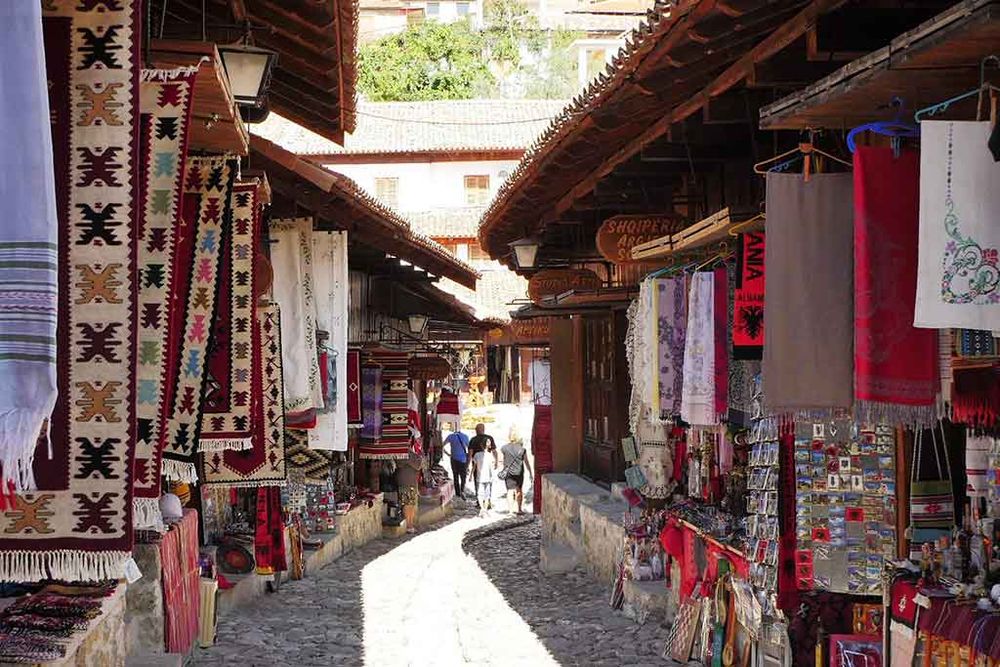
There is no shopping experience in Albania quite like Kruja's Old Bazaar. Zenith Travel, Albania's leading tour operator since 1993, includes dedicated time at the bazaar on every Kruja day trip with a guided market tour from Tirana, because the market deserves more than a rushed walk through. This guide tells you exactly what to look for, what to skip, and how to leave Kruja with something genuinely worth taking home.
What makes this bazaar different?
Most tourist markets in the Balkans have turned into souvenir strips. Mass produced items, imported stock, the same fridge magnets in every stall.
Kruja's Old Bazaar has resisted this. Most of the small wooden storefronts lining the cobblestone lane below the castle walls are run by local artisans who produce the goods they sell, often in the workshop directly behind the shop. When you buy a kilim at Kruja, the woman who wove it is frequently the one handing it to you.
The physical setting reinforces the authenticity. The lane of timber framed shops follows the natural slope of the castle ridge, with the fortress visible above and the valley spread out below. Walking its full length takes about fifteen minutes at a relaxed pace. A proper shopping visit takes considerably longer.
Handwoven kilims: the signature purchase.
Kilims are what Kruja is most famous for and they fully deserve the reputation. Albanian kilims follow geometric patterns that vary by region and family tradition. Deep reds, blues, and blacks dominate the traditional palette alongside natural cream and brown wool tones. The weaving is a flat weave without pile, meaning kilims are reversible, lightweight for their size, and durable enough to use as floor coverings for decades.
Sizes range from small decorative pieces that fit easily in a suitcase to large room sized rugs. Most vendors will roll and wrap pieces for travel. Several can arrange international shipping for larger purchases.
What to check before buying
Look at the backThe weaving should be consistent and the pattern even. Patchy colour can indicate lower quality dyes.
Ask about materialsThe best kilims are made with natural wool and traditional pigments. Ask the vendor directly if it matters to you — they will answer honestly.
Negotiate freelyPrices are significantly lower than comparable handwoven textiles in Western European craft markets, and negotiating on larger pieces is expected and normal.
Copper and bronze crafts.
Several workshops at the bazaar produce hand engraved copper items using tools and techniques that have not changed substantially in centuries. The most practical purchases are small engraved coffee cups and saucers in the Albanian style, ibrik style coffee pots, and decorative plates with geometric or eagle motifs. These pack relatively flat, survive travel well, and are items people actually use rather than just display.
Watching a craftsperson at work on a copper piece — the steady tap and trace of the engraving tool producing patterns in the metal — is one of the more meditative experiences the bazaar offers. If a stall has a craftsperson working, stop and watch for a few minutes before you browse the finished pieces. It changes what you see.
Silver filigree jewellery.
Albanian silver filigree is a delicate wirework tradition producing earrings, pendants, bracelets, and pins in traditional patterns. The national motif, the double headed eagle, features prominently and makes for a meaningful and portable purchase.
Quality varies between vendors. Genuine silver filigree has a weight and intricacy that distinguishes it immediately from cheaper alloy imitations. When in doubt, ask whether the piece is solid silver and check for a hallmark. The better jewellery vendors at Kruja are used to this question and answer it without any hesitation.
Antiques and vintage items.
Several stalls specialise in items accumulated from across Albania over many years. Ottoman era coins, communist period memorabilia, vintage military badges, old photographs, traditional costumes, and occasionally pieces of antique furniture or household objects.
Quality and authenticity vary enormously between vendors and between individual pieces. For items without specific collector knowledge, the communist era pieces are the most accessible and interesting purchases. Enamel badges, old banknotes, and propaganda booklets carry a clear historical context that does not require expertise to appreciate. Prices are low and the stories behind them are fascinating with a bit of context from your guide.
One practical note: Albanian authorities have restrictions on the export of genuine archaeological artefacts. If a vendor presents something of apparent archaeological significance, ask your guide before purchasing.
Traditional textiles and embroidery.
Beyond kilims, the bazaar sells hand embroidered tablecloths, cushion covers, wall hangings, and traditional garment pieces. Albanian embroidery uses bold geometric patterns and strong colour combinations that reflect the same visual language as the kilim tradition.
These items are generally more affordable than the larger rugs and travel more easily, which makes them practical gifts as well as personal purchases. Traditional Albanian folk costume elements, embroidered sashes, and decorative aprons are available at accessible prices and make visually striking things to bring home.
How to shop: the practical rules.
Bring cash in Albanian lekCard payment is not universally accepted at the smaller stalls and the bazaar has no ATM nearby. Come prepared with a range of smaller bills as large denomination notes can be difficult to change.
Negotiate above small purchasesThe opening price is a starting point, not a final number, particularly for kilims, copper pieces, and antiques. Keep it friendly — vendors are accustomed to it and will not take offence at a reasonable counter offer.
No obligation to buyThe culture of the bazaar is one of open display and unhurried looking. Browsing without buying is completely normal and no vendor will pressure you.
LanguagesSeveral vendors speak English. Many also speak Italian and some speak Greek, reflecting Albania's emigrant population patterns.
What to avoid.
A small number of stalls sell items that appear to be traditional Albanian crafts but are mass produced imports. They are usually identifiable by their uniform appearance, lighter weight, and significantly lower price compared to genuinely handmade equivalents.
If a kilim is priced dramatically below everything around it and the pattern looks machine perfect rather than hand varied, it is almost certainly machine made. The same applies to copper items that lack the slight irregularities of genuine hand engraving. When in doubt, compare two or three pieces of the same type across different stalls before committing.
How long to spend at the bazaar.
A relaxed walk through the full length of the bazaar and back takes about thirty minutes. Add time to stop in the more interesting stalls and talk to craftspeople and you are looking at an hour to ninety minutes easily.
If you are a serious shopper with kilims or copper pieces on your list, budget two hours. The bazaar also has several small café stalls serving coffee and traditional Albanian byrek baked pastry, which makes it a natural place to stop and sit for twenty minutes in the middle of the visit rather than rushing through in one pass.
Let us take you to Kruja Bazaar.
Zenith Travel includes dedicated time at the bazaar on every Kruja day trip, with a local guide who knows the craftspeople and the stories behind each piece. Leave Kruja with something genuinely worth taking home.
Book a guided tour →
Godina 173, Kavaja St 23, Ap 3, Tiranë 1001, Albania
Phone: +355 69 400 0016
Website: visitalbania.zenith.travel
Explore more
→ A Complete First Timer's Guide to Kruja Castle
→ Shkodra vs Kruja: Which Albanian Town Should You Visit First?
→ Who Was Skanderbeg? Albania's National Hero Explained
→ The Best Time to Visit Shkodra and Kruja: A Seasonal Guide
→ Best Day Trips from Tirana: A Complete Guide for 2026